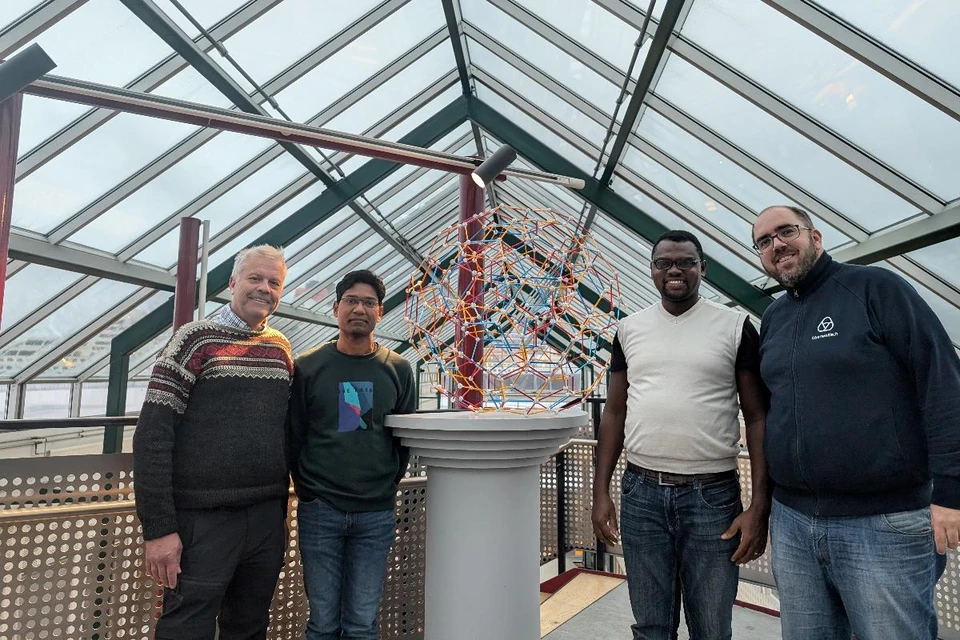
A living mathematical heritage
The center is named after Sophus Lie and Carl Størmer. Their work on mathematical structures and computation continues to inform the subjects we study.
Explore the lineage
Imagination, Exploration and Collaboration
A film by the Lie–Størmer Center
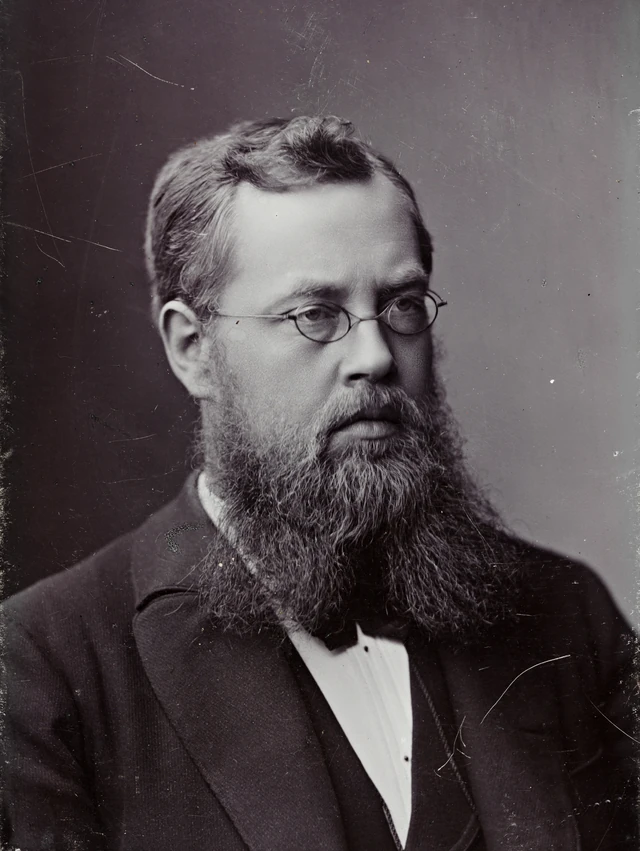
Sophus Lie
1842–1899
The structure beneath change
What stays the same when something changes? Sophus Lie made symmetry a way to understand differential equations. His continuous transformation groups opened a new language for mathematics.
The ideas that bear his name continue to connect algebra, geometry and the study of differential equations. They are part of the mathematical foundation on which the center builds.
Read the biography
Lie revolutionized the theory of differential equations through his theory of continuous transformation groups — the Lie groups. By studying the symmetries of equations, he unified analytic techniques for solving differential equations within a single conceptual framework.
Lie theory today forms the foundation of theoretical physics, underpinning general relativity, quantum field theory, and particle physics. Although his solution methods were too advanced for practical computation in the 19th century, the advent of computers transformed Lie's ideas into powerful tools for symbolic and numerical computation.
Modern research in algebra, geometry, and computational differential equations continues to draw on Lie theory as a unifying principle, advancing both pure mathematics and computational methods.
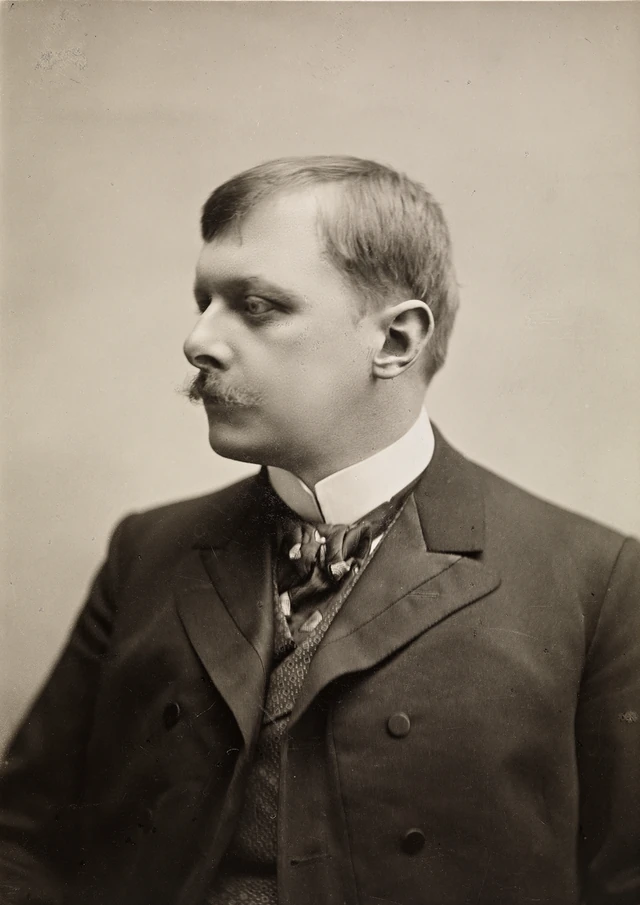
Carl Størmer
1874–1957
From equations to the northern lights
For Carl Størmer, the northern lights posed a mathematical question. How do charged particles move through the Earth’s magnetic field? His search for an answer brought together mathematical analysis, calculation and observation.
That movement between abstract ideas and the physical world is central to the tradition the Lie–Størmer Center carries forward.
Read the biography
Størmer began his career in number theory and pure mathematics, but inspired by Kristian Birkeland's theory of the northern lights, he turned toward computational mathematics. Seeking to explain the aurora through the motion of charged particles in Earth's magnetic field, he developed the celebrated Størmer's method.
His work demonstrates how mathematical theory can illuminate practical problems in geophysics and computational physics.
Størmer's methods remain foundational for understanding charged particle motion and continue to influence modern computational approaches in physics and mathematics.
Ideas live on through people.
The connection between Lie and Størmer was more than a shared nationality. In 1902, Størmer helped edit and publish one of Lie’s posthumous works. He also taught Lie’s transformation groups in his seminar, passing those ideas to another generation of mathematicians.
Research, teaching and collaboration keep a mathematical tradition alive. This is the inheritance the center sets out to carry forward.
Read about Størmer’s seminar and work on Lie’s papersA few moments in a longer story
From the publication of foundational ideas to a new place for mathematical exchange.
1888–1893
SourceA language for symmetry
Lie and Friedrich Engel publish the three volumes of Theorie der Transformationsgruppen.
1902
SourceAn inheritance passed on
Størmer and Alf Guldberg edit and publish a posthumous work by Lie on integral invariants and differential equations.
1955
SourceTheory meets observation
Størmer’s The Polar Aurora brings together decades of mathematical and observational work.
2024
SourceA new home for the tradition
The Lie–Størmer Center officially opens on 17 January, creating a meeting place for the Norwegian mathematics community.
The center today
Research, teaching and visits in Tromsø and Bergen.
Opened in January 2024 at UiT – The Arctic University of Norway, in collaboration with the University of Bergen, the center brings researchers and students together around fundamental mathematics and computation.
The center’s activities include research projects, scientific meetings and doctoral teaching through Mathesis.
The co-director on the center’s first year